
Choosing the best mattress type for back pain involves more than deciding whether you prefer a soft or firm bed.
The right mattress should feel comfortable, support your body through the night, and make it reasonably easy to change position and get out of bed. Your sleeping position, body weight, pain pattern, mobility, and personal preferences can all affect what feels right.
There is no single mattress that works for everyone with back pain.
A mattress that feels supportive to a back sleeper may feel too firm for a side sleeper. A deeply contouring foam mattress may feel comfortable to one person but make turning difficult for someone with limited mobility.
That is why it helps to compare the features that actually affect comfort and support before looking at individual brands.
This guide walks through 15 practical checks to help you narrow the choices. Once you know which features matter most to you, you can move on to comparing specific mattresses with much more confidence.
Start With the Right Mattress Feel and Support
The first five checks deal with the way a mattress feels and responds to your body.
Firmness, support, pressure relief, material, and thickness all work together. Looking at only one feature—such as whether a mattress is labelled “firm”—can give you an incomplete picture.
1. Firmness: Firmer or Softer Mattress for Lower Back Pain?
One of the first questions people ask is whether a firmer or softer mattress for lower back pain is better.
Very firm is not automatically better.
Research on nonspecific low back pain has generally found that medium-firm mattresses are a reasonable starting point for many adults. They can provide support without creating the hard pressure points that some people experience on very firm surfaces.
But firmness labels are not standardized perfectly across brands, and the same mattress can feel different depending on your body size and sleeping position.
For example:
- Side sleepers often need more cushioning around the shoulders and hips.
- Back sleepers may prefer a medium to medium-firm feel that supports the natural curves of the body.
- Stomach sleepers generally need enough support to prevent the midsection from sinking too deeply.
- Heavier sleepers may experience the same mattress as softer than a lighter person does.
So instead of searching for the firmest mattress available, look for a surface that feels supportive without creating uncomfortable pressure.
A medium-firm mattress for back pain is a useful place to begin your comparison, but your own comfort still matters.
2. Support: Does the Mattress Keep You Comfortably Supported?
Firmness describes how hard or soft the surface feels. Support describes how well the mattress holds your body in a comfortable position.
They are not the same thing.
A mattress can feel soft at the surface while still having a supportive core underneath. Conversely, a very firm mattress can feel hard without necessarily providing better support for your body.
When lying down, pay attention to whether:
- your hips sink much lower than the rest of your body;
- your shoulders feel pushed upward;
- you feel as though you are sagging into the centre;
- the mattress feels uneven from one area to another; or
- you struggle to maintain a comfortable position through the night.
Good support should help distribute your body weight without making you feel as though you are sinking into a hollow.
For seniors, support also has a practical dimension. A mattress that is extremely soft may make rolling over, sitting up, or getting out of bed more difficult.
The goal is not perfect “spinal alignment” at every moment. It is a sleep surface that supports your body comfortably and allows you to move without excessive effort.
3. Pressure Relief and Contouring
Pressure relief is especially important if you sleep on your side or regularly wake with discomfort around the hips, shoulders, or other bony areas.
A mattress that contours slightly to your body can spread your weight across a larger surface area rather than concentrating it at a few pressure points.
Memory foam and latex are often chosen for this reason, although they feel quite different.
Too little contouring may make the mattress feel hard at the hips and shoulders.
Too much can create the opposite problem. If you sink deeply into the mattress, changing position may require more effort, particularly if you have painful joints, reduced upper-body strength, or limited mobility.
When assessing pressure relief, ask:
- Do my shoulders and hips feel cushioned?
- Can I change position without struggling?
- Do I feel supported rather than trapped in the mattress?
- Do I wake with new pressure-point discomfort?
The ideal amount of contouring is therefore a balance: enough cushioning for comfort, but not so much that movement becomes difficult.
4. Mattress Type and Material
The best mattress type for back pain depends partly on how you prefer the mattress to respond when you lie down and move.
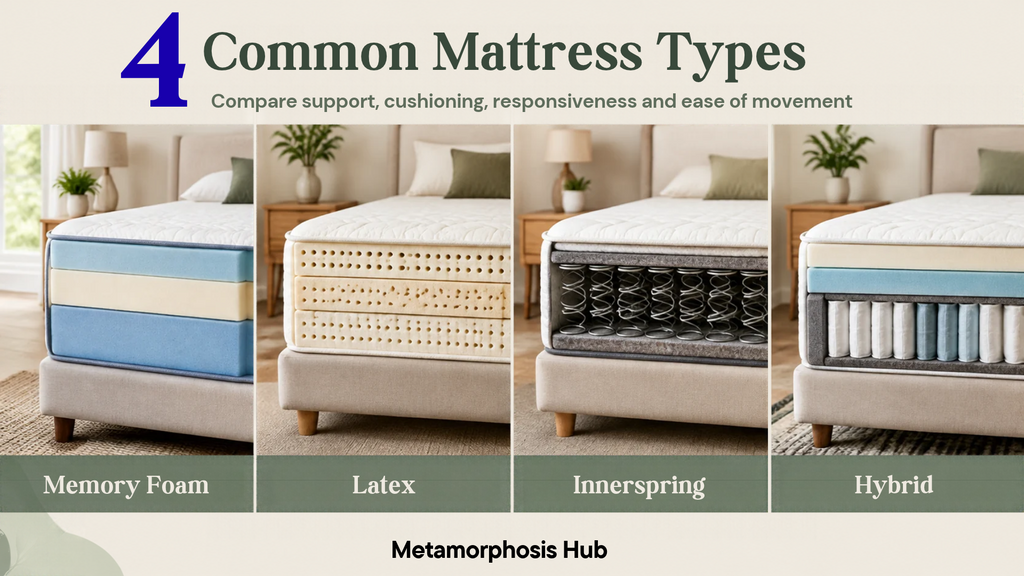
The four common categories are memory foam, latex, innerspring, and hybrid mattresses.
Memory Foam
Memory foam conforms closely to the body and can provide good pressure relief.
It may suit people who prefer a cushioned, body-hugging feel or who want strong motion isolation when sharing a bed.
The downside is that deeper memory foam can feel slow to respond. Some sleepers find it harder to roll over or sit up, and some foams retain more heat than other materials.
Latex
Latex also cushions the body but generally feels more responsive and springy than memory foam.
Because it rebounds quickly, it can be easier to move on. That may appeal to seniors who find deeply contouring foam restrictive.
Latex tends to be durable and may sleep cooler than traditional memory foam, although latex mattresses are often heavier and can cost more.
Innerspring
Traditional innerspring mattresses use coils as the main support system with relatively thin comfort layers above them.
They usually feel more responsive and make changing position easier, but pressure relief depends heavily on the quality and thickness of the comfort layers.
Hybrid
Hybrid mattresses combine a substantial foam or latex comfort layer with a coil support system.
They are popular because they can offer a compromise between cushioning and responsiveness.
For someone comparing mattress types for back pain, a hybrid may be worth considering when you want pressure relief but do not like the deeper sinking sensation of an all-foam mattress.
There is no universally superior material. The better choice is the one that gives you the right balance of support, cushioning, temperature comfort, and ease of movement.
5. Mattress Thickness
Mattress thickness is often marketed as though thicker automatically means more luxurious or supportive.
It does not.
A thicker mattress simply has more room for support and comfort layers. The quality and design of those layers matter more than the number of inches alone.
Still, thickness can affect several practical issues.
A taller mattress may:
- raise the overall height of the bed;
- make getting in or out easier for some people and harder for others;
- require deep-pocket fitted sheets;
- add considerable weight;
- affect compatibility with an adjustable base or bed frame.
For seniors, bed height deserves particular attention.
Sit on the edge of the bed and check whether your feet can reach the floor comfortably and whether you can stand without excessive effort. Adding a thick mattress to a high bed frame can make getting into bed difficult, while a very low setup can make standing harder for painful knees, hips, or backs.
Also remember that a 12-inch mattress is not automatically more supportive than a 10-inch model. Construction, firmness, materials, and support layers matter far more than thickness by itself.
Choose mattress thickness as part of the overall design—not as a shortcut for judging quality.
A 2026 systematic review of 47 studies found that medium-firm mattresses had the most consistent evidence for pressure distribution, sleep quality, morning stiffness and nonspecific low-back pain, while also emphasizing body characteristics, age, sleep position and thermal comfort. PubMed A randomized trial likewise found better outcomes with medium-firm than firm mattresses for chronic nonspecific low-back pain. PubMed
Match the Mattress to Your Body and Sleep Habits
A mattress can look ideal on paper and still feel wrong once you sleep on it.
Your sleeping position, body weight, mobility, whether you share the bed, and how warm you sleep can all change how a mattress feels. These next five checks help narrow the options based on how you actually use the bed.
6. Sleeping Position
Your usual sleeping position influences how much cushioning and support you may need.
Side sleepers place more pressure on the shoulders and hips, so they often prefer a little more cushioning around those areas.
Back sleepers usually need enough support to keep the hips from sinking too deeply while still allowing the lower back to rest comfortably.
Stomach sleepers may prefer a somewhat firmer surface because excessive sinking around the midsection can feel uncomfortable.
If you change position frequently during the night, consider how easily you can turn over. Deep, slow-moving foam may feel comfortable at first but can make repositioning harder for some people.
Rather than choosing a mattress solely by its firmness label, think about whether it supports your preferred sleeping position without creating uncomfortable pressure.
7. Body Weight
Body weight affects how firm or soft a mattress feels.
A lighter person may not sink very far into a firm mattress and may therefore experience more pressure at the shoulders or hips. A heavier person may compress the same mattress more deeply and need a more supportive construction.
That does not mean there is a specific mattress firmness for every weight category.
Instead, consider whether:
- you sink excessively into the mattress;
- the surface feels uncomfortably hard;
- you can change position easily; and
- the mattress still feels supportive beneath the hips and shoulders.
This is another reason mattress firmness ratings should be treated as a starting point rather than a guarantee of comfort.
8. Edge Support and Ease of Getting Out of Bed
Edge support describes how stable the mattress feels near its perimeter.
It matters if you:
- sleep close to the edge;
- sit on the bed while dressing;
- use the edge to help you stand; or
- have difficulty getting in and out of bed.
A mattress with weak edges may compress noticeably when you sit on it, which can make standing more difficult.
For older adults or anyone with knee, hip, balance, or mobility problems, a stable mattress edge can be particularly useful.
When testing a mattress, sit near the edge for a few minutes. Check whether you feel secure and whether you can stand without sinking deeply into the surface.
Edge support should improve stability without making the entire mattress feel unnecessarily rigid.
9. Motion Isolation and Noise
If you share a bed, your partner’s movements can interrupt your sleep even when the mattress itself feels comfortable.
Motion isolation refers to how well a mattress prevents movement on one side from travelling across the bed.
Memory foam often performs well in this area because it absorbs movement. Individually pocketed coils can also reduce motion transfer compared with older interconnected spring systems.
Noise matters for the same reason.
Some traditional innerspring mattresses may squeak or become noisier as they age, while foam and latex mattresses are generally quieter.
Neither feature directly determines whether a mattress is suitable for back pain, but repeated sleep disruption can make an otherwise comfortable mattress less satisfying.
For couples, motion isolation and noise are therefore useful secondary considerations after support and comfort.
10. Temperature Regulation
A mattress that makes you too hot can interrupt sleep regardless of how supportive it feels.
Different materials handle heat differently.
Traditional memory foam can retain more body heat because it contours closely around the sleeper. Some newer foams use open-cell structures, perforations, breathable covers, or cooling materials to improve airflow.
Latex generally feels more responsive and often allows better airflow than dense memory foam.
Hybrid and innerspring mattresses can also sleep cooler because air can circulate through the coil system.
If you regularly sleep hot, look beyond marketing terms such as “cooling” and consider the overall construction:
- breathable cover materials;
- airflow through the support layers;
- how deeply you sink into the surface; and
- whether bedding and mattress protectors may also be trapping heat.
Temperature control will not determine the best mattress type for back pain on its own, but comfortable sleep temperature can make it easier to rest through the night.
Check Practical Features Before You Buy
Once you have narrowed down the firmness, support, material, and sleep features that suit you, look at the practical details that affect how easy the mattress is to own.
These final five checks can help prevent an expensive purchase from becoming frustrating later.
11. Allergies, Cover Materials and Ease of Cleaning
If allergies or sensitivities are a concern, check the materials used in both the mattress and its cover.
Look for features such as:
- a removable or washable cover;
- breathable fabrics;
- clear care instructions; and
- materials that are easy to keep clean.
A washable cover can be especially useful if spills or accidents are a concern.
Also check whether the manufacturer recommends spot cleaning only or allows the cover to be removed and machine washed.
Do not assume that a mattress described as “hypoallergenic” will automatically suit everyone with allergies. Review the actual materials and care instructions before buying.
12. Durability and Construction Quality
A mattress may feel comfortable when new but still be a poor investment if it quickly develops sagging or uneven areas.
Look at the quality of the materials and construction rather than relying only on the brand name or price.
Useful questions include:
- What type of foam or coil system is used?
- Does the manufacturer explain how the mattress is constructed?
- Are there repeated customer complaints about sagging or loss of support?
- How long is the mattress expected to retain its shape and comfort?
Durability matters because changes in the mattress surface can affect the support and comfort you originally chose it for.
Customer reviews can help identify recurring problems, but use them as one source of information rather than as proof that a mattress will work for your back pain.
13. Certifications
Mattress certifications can provide useful information about materials and manufacturing standards.
For example:
- CertiPUR-US is commonly used for polyurethane foam.
- OEKO-TEX Standard 100 relates to testing textiles for certain harmful substances.
These labels can help you compare materials, particularly if chemical emissions or fabric safety are important to you.
However, certifications do not tell you whether a mattress will relieve back pain or feel comfortable.
Think of them as a quality or materials check—not as evidence that one mattress is medically better than another.
14. Trial Period, Return Policy and Warranty
A mattress can feel very different after several full nights of sleep than it does during a brief test.
That makes the trial period one of the most important practical features, especially when buying online.
Before ordering, check:
- how long the sleep trial lasts;
- whether there is a minimum break-in period;
- whether returns are free;
- who pays return shipping;
- whether the mattress must be repackaged; and
- whether pickup is available for returns.
Also review the warranty carefully.
A long warranty may sound reassuring, but what matters is what it actually covers. Look for details about manufacturing defects, sagging, impressions, and exclusions.
Do not assume that discomfort alone will qualify for a warranty claim. That is what the trial period is for.
15. Budget, Delivery and Setup
Decide on a realistic budget before you begin comparing mattresses.
The most expensive mattress is not automatically the best one for your back pain. Focus instead on finding the combination of firmness, support, material, comfort, and practical features that suits your needs.
Then check the full cost of getting the mattress into your home.
Consider:
- delivery charges;
- whether the mattress arrives boxed or full-size;
- whether setup is included;
- whether old-mattress removal is available; and
- whether you will need help moving or unpacking it.
Mattresses can be heavy and difficult to handle, particularly for older adults or anyone with back, hip, or mobility problems.
If lifting and setup may be difficult, a delivery service that places the mattress in the bedroom—or removes the old mattress—may be worth paying for.
By the time you have worked through these 15 checks, you should have a much clearer idea of the mattress features that matter most to you before moving on to specific brands or models.
Mattress or Mattress Topper: Which Makes More Sense?
A mattress topper can be useful when your mattress is still structurally sound but feels too firm, too warm, or short on surface cushioning.
A topper changes the feel of the top few inches of the bed. It does not repair a mattress that has lost its support.
A topper may be worth considering when:
- the mattress is still flat and supportive;
- you mainly want more cushioning at the hips or shoulders;
- you want to adjust firmness without replacing the whole bed; or
- you want a lower-cost way to test a different sleep surface.
A new mattress usually makes more sense when:
- the surface is visibly sagging;
- there are deep body impressions;
- the mattress feels uneven;
- the support has clearly broken down; or
- the bed is old enough that comfort changes are coming from the mattress itself.
If you are deciding between a mattress topper or new mattress, start by checking the condition of the mattress underneath.
A topper can improve comfort, but it cannot correct a worn-out support system.
For a closer look at topper materials, thickness, and arthritis-related comfort, see our guide to the best mattress topper for arthritis.
Buying a Mattress Online: 5 Things to Check
Buying a mattress online gives you access to more models, specifications, and customer reviews, but it also means you cannot fully judge the mattress before it arrives.
These five checks matter most.
1. Sleep Trial
Look for a trial period that gives you enough time to sleep on the mattress at home.
A short showroom test cannot tell you how the mattress will feel after several nights.
2. Return Policy
Check whether returns are free, whether pickup is included, and whether there is a minimum number of nights you must keep the mattress before returning it.
Some mattresses are difficult to repackage once expanded.
3. Warranty
Review what the warranty actually covers.
Pay particular attention to sagging, manufacturing defects, and exclusions. A long warranty period does not automatically mean broad coverage.
4. Delivery and Setup
Find out whether the mattress arrives compressed in a box or at full size.
If lifting, carrying, or setup could be difficult, look for room-of-choice delivery, setup service, or old-mattress removal.
5. Customer Service
Check whether the company provides clear contact information and whether buyers consistently report problems with returns, refunds, or warranty claims.
Online shopping can make comparison easier, but the safest purchase is one backed by a clear trial, return policy, warranty, and delivery plan.
Ready to Compare Specific Mattresses?
Once you know which firmness, support level, material, sleeping-position features, and practical details matter most, comparing individual mattresses becomes much easier.
Instead of choosing based on advertising claims or star ratings alone, you can ask whether each mattress actually matches your priorities.
That is where the product-comparison guide comes in.
See our guide to the best mattresses for back pain to compare current models, key specifications, pros and cons, and which sleepers each option may suit best.
Conclusion
Choosing the best mattress type for back pain starts with understanding what your body and sleep habits actually need.
Firmness matters, but so do support, pressure relief, sleeping position, body weight, edge stability, temperature, trial terms, and ease of setup.
The goal is not to find one mattress that is universally “best.” It is to narrow the choices to the models that match your comfort, mobility, and practical needs.
Once you know your priorities, use a generous sleep trial whenever possible and compare specific mattresses with those criteria in mind.
FAQs About Choosing the Best Mattress Type for Back Pain
What mattress type is best for back pain?
There is no single best mattress type for everyone. Memory foam, latex, innerspring, and hybrid mattresses can all work well when they provide the right balance of support, pressure relief, comfort, and ease of movement.
Is a firmer or softer mattress better for lower back pain?
A very firm mattress is not automatically better. Medium-firm mattresses are often a useful starting point, but body weight, sleeping position, mobility, and personal comfort should guide the final choice.
Is a medium-firm mattress good for back pain?
A medium-firm mattress may work well for many people because it can balance support with cushioning. However, firmness labels vary by brand, so the way the mattress feels to you matters more than the label alone.
How long should you try a new mattress before deciding?
A few minutes in a showroom is not enough. Use the mattress through the available sleep-trial period and pay attention to comfort, ease of movement, morning stiffness, and whether your sleep quality improves.
Can a mattress topper help instead of buying a new mattress?
Yes, if the mattress underneath is still flat and supportive. A topper can change cushioning and surface feel, but it cannot fix sagging, deep impressions, or a worn-out support system
References
Davenport, S & Laverone, K (2023). 10 best mattresses: What to consider and quiz https://www.medicalnewstoday.com/articles/how-to-choose-the-best-mattress
Kovacs, F.M (2003). Effect of firmness of mattress on chronic non-specific low-back pain: randomised, double-blind, controlled, multicentre trial. Lancet 362(9396):1599-604