

Lower back pain often improves within a few days or weeks. But when lower back pain is not going away after several months, the explanation may be more complicated than a strained muscle or one “bad disc.”
Pain that persists or repeatedly returns for more than about 12 weeks is generally considered chronic lower back pain. Some people have an identifiable condition such as spinal stenosis, arthritis, nerve compression, or a vertebral fracture. In others, several factors interact and no single structure fully explains why the pain continues.
The causes of chronic lower back pain can therefore include spinal conditions, previous injuries, muscle deconditioning, nerve irritation, inflammatory disease, and other medical problems. Persistent pain may also be influenced by sleep, activity levels, stress, movement patterns, and changes in how the nervous system processes pain.
Importantly, chronic pain does not automatically mean that your spine is continuing to deteriorate.
This guide looks at 13 reasons for chronic lower back pain, why symptoms can last for months, and when persistent pain deserves another medical assessment.
For a broader overview of symptoms, warning signs, and treatment pathways, see our guide to back pain in seniors.
Disclosure: As an Amazon Associate, this site earns from qualifying purchases. Some links in this article may lead to Amazon products, and if you buy through them the site may earn a small commission at no extra cost to you.

What Is Chronic Lower Back Pain?
Chronic lower back pain generally means pain between the lower ribs and buttocks that has persisted or repeatedly returned for more than three months.
The word chronic describes duration, not severity or permanent damage. Some people experience mild or intermittent symptoms, while others have pain that significantly affects walking, sleep, work, or everyday activities.
WHO broadly distinguishes chronic lower back pain into two groups:
Chronic secondary lower back pain occurs when symptoms can be linked to an identifiable condition, such as a fracture, inflammatory disease, infection, cancer, or another structural or medical disorder.
Chronic primary lower back pain describes persistent or recurring pain that cannot be reliably attributed to one disease or structural lesion. This is the more common pattern in primary care.
That does not mean the pain is imaginary.
It means persistent pain may be influenced by several interacting factors, including:
- reduced strength and physical conditioning;
- nervous-system sensitivity;
- sleep problems;
- fear of movement;
- emotional distress;
- other health conditions; and
- reduced physical activity.
This helps explain why two people with similar MRI findings can experience very different levels of pain and disability.
Lower Back Pain Not Going Away? Why Pain Can Last for Months
If you have had lower back pain for months, it is natural to wonder why your back has not simply healed.
Sometimes an ongoing condition such as spinal stenosis, arthritis, nerve compression, or osteoporosis-related fracture continues to produce symptoms.
In other cases, the original injury is no longer the whole story.
Several Factors May Keep Pain Going
An episode of back pain may begin after lifting, twisting, falling, or another strain. As pain continues, it may affect how much a person moves, sleeps, exercises, and participates in normal activities.
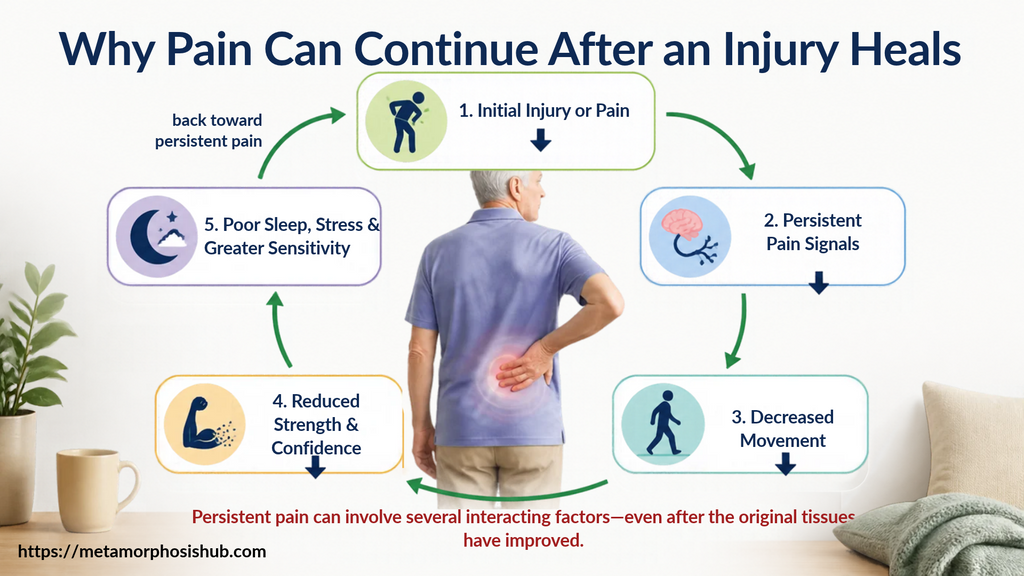
That can create a cycle:
Pain → less activity → reduced strength and confidence → everyday movement becomes harder → more pain and avoidance.
Several factors may then overlap. Someone might have mild spinal stenosis, reduced leg strength, poor sleep, and fear of walking because previous activity triggered pain.
Treating only one contributor may therefore produce limited improvement.
The Nervous System Can Become More Sensitive
When pain continues for a long time, the nervous system may become more responsive to signals associated with movement or discomfort.
This does not mean the pain is “all in your head.” Pain remains a genuine physical experience.
Instead, persistent pain can involve changes in how the brain, spinal cord, and peripheral nerves process sensory information. This helps explain why pain severity does not always match the amount of structural damage seen on imaging.
Chronic Pain Can Flare Up
Chronic lower back pain often has an up-and-down pattern.
Symptoms may temporarily worsen after:
- extra activity;
- prolonged sitting or standing;
- poor sleep;
- illness or stress; or
- sometimes no obvious trigger.
A flare-up does not automatically mean new spinal damage has occurred.
However, new symptoms that differ significantly from your usual pattern—particularly weakness, numbness, bowel or bladder changes, fever, unexplained weight loss, or pain following a fall—should not simply be assumed as another routine flare.
Persistent Does Not Mean Permanent
Having lower back pain for months can be discouraging, but chronic does not mean that nothing can improve.
Strength, activity levels, sleep, confidence in movement, and management of underlying conditions can all influence how well someone functions even when some pain remains.
The first step is understanding why the lower back pain not going away can be worrisome.
That brings us to the 13 most important causes of chronic lower back pain.
13 Causes of Chronic Lower Back Pain
The causes of chronic lower back pain are not the same for everyone. Some people have a clearly identifiable spinal condition, while others have several smaller problems that interact and keep symptoms going.
Mechanical and structural problems are common, but chronic pain can also involve nerves, bones, inflammatory disease, muscle deconditioning, or changes in how the nervous system processes persistent pain. In fact, more than one factor may be present at the same time.
Here are 13 important causes and contributors to consider.
1. Degenerative Disc Changes
The discs between the vertebrae act as cushions and allow the spine to move. Over time, they may lose water, become thinner, and develop small tears or other degenerative changes.
In some people, these changes can contribute to discogenic pain—pain thought to arise from the disc itself—or alter the way nearby joints and structures handle movement.
However, disc degeneration is extremely common with age and does not automatically mean it is causing the pain. A scan must be interpreted alongside symptoms and physical findings.
When disc changes do contribute to chronic lower back pain, symptoms may include aching in the lower back, stiffness, and discomfort aggravated by certain positions or activities.
2. Osteoarthritis and Facet Joint Pain
The small facet joints at the back of the spine guide movement between the vertebrae. Like knees, hips, and hands, these joints can develop osteoarthritis.
Cartilage may deteriorate, joints can enlarge, and bone spurs may form. In some people, these changes contribute to persistent localised pain and stiffness.
Facet-related pain often remains primarily in the lower back but may spread into the buttocks or upper thighs.
Again, arthritis visible on imaging is not proof that the joint is responsible for a person’s symptoms. Degenerative changes become common with age, and many occur without significant pain (niams.nih.gov).
3. Lumbar Spinal Stenosis
Spinal stenosis occurs when spaces within the spinal canal or around the nerve roots become narrower.
Age-related changes—including thickened ligaments, enlarged facet joints, bone spurs, disc bulging, and spondylolisthesis—can all contribute to this narrowing.
Some people experience lower back pain, but the more distinctive symptoms may involve the buttocks or legs.
Pain, heaviness, numbness, or weakness may become worse during standing or walking and improve with sitting or leaning forward. This pattern is known as neurogenic claudication.
Because spinal stenosis often develops gradually, symptoms can persist for months or years and may increasingly limit walking.
4. Herniated Discs and Nerve Compression
A spinal disc can bulge or herniate enough to irritate a nearby nerve root.
When this happens, symptoms may extend beyond the lower back. Pain can travel into the buttock and down the leg, sometimes accompanied by numbness, tingling, burning, or weakness.
This type of nerve-root pain is often called radiculopathy, and irritation of nerve roots contributing to the sciatic nerve is commonly described as sciatica.
A disc herniation does not always produce chronic symptoms, and many improve with time. However, persistent nerve irritation or compression can be one reason lower back and leg pain continue.
If nerve irritation is causing pain into the buttock or leg, our guide to sciatica and nerve pain explains the condition in more detail.
5. Spondylolisthesis and Spinal Instability
Spondylolisthesis occurs when one vertebra moves forward relative to the vertebra below it.
It may result from degenerative changes, a stress-related defect in part of the vertebra, previous injury, or other structural problems.
When the movement alters spinal mechanics or narrows the space available for nerves, it can contribute to persistent lower back pain, stiffness, or nerve-related symptoms.
Degenerative spondylolisthesis becomes more relevant with age and can occur alongside spinal stenosis and facet-joint arthritis.
6. Persistent Muscle and Myofascial Pain
Not all chronic low back pain causes involve bones or discs.
Muscles and connective tissues around the spine can remain painful after repeated strain, overuse, poor conditioning, or changes in movement.
Myofascial pain can involve areas of muscle tightness and tenderness that continue to produce aching or discomfort. NIAMS includes myofascial pain among recognised mechanical or structural contributors to back pain (niams.nih.gov).
Persistent muscle pain can also coexist with arthritis, disc problems, or nerve symptoms, making it difficult to identify one single source.
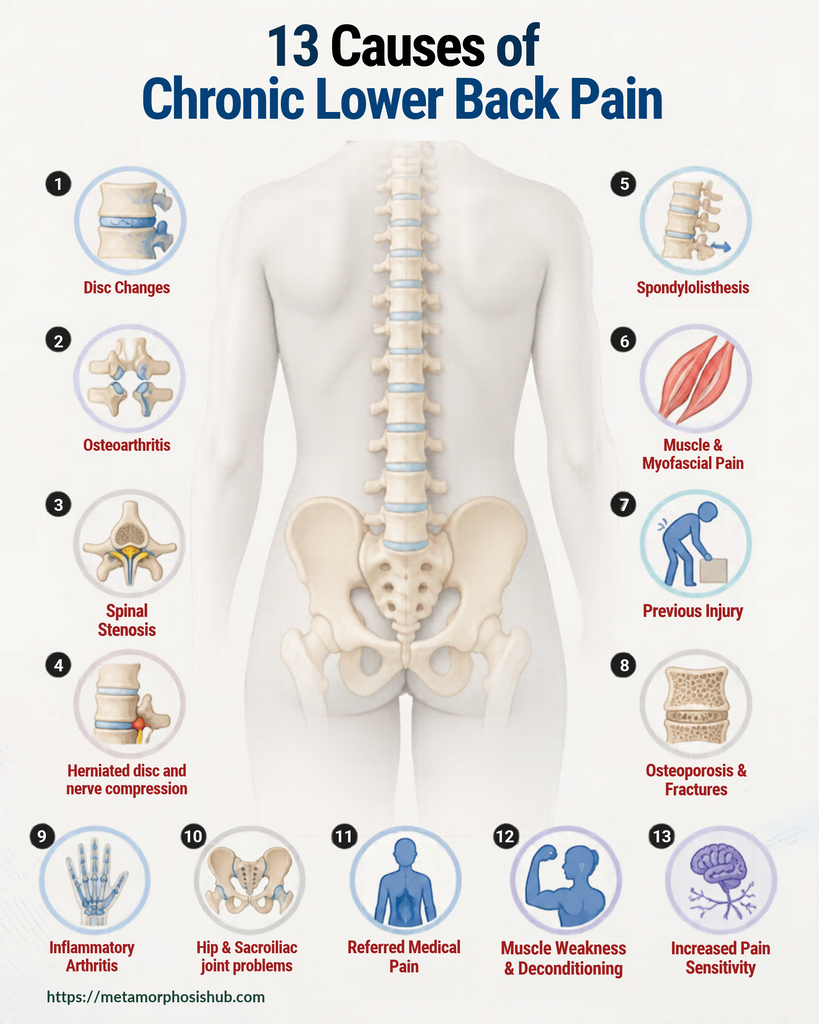
7. Previous Injuries and Repeated Strain
A previous fall, lifting injury, sports injury, workplace accident, or motor vehicle collision can sometimes contribute to chronic lower back problems.
The initial injury may involve muscles, ligaments, discs, joints, or vertebrae.
Even after damaged tissues have healed, changes in movement, reduced activity, muscle weakness, or recurring irritation may contribute to ongoing symptoms.
Repeated smaller strains can matter too. Regularly lifting, twisting, or performing physically demanding activities can aggravate an already sensitive back, particularly when recovery time is limited.
A previous injury does not guarantee chronic pain, but it can be one part of the explanation when symptoms repeatedly return.
8. Osteoporosis and Vertebral Compression Fractures
Osteoporosis weakens bones and increases risk that a vertebra may fracture or partially collapse.
A vertebral compression fracture can cause sudden severe pain, but some fractures produce less dramatic symptoms and may initially be mistaken for ordinary back pain.
One fracture can also change spinal alignment and place additional demands on surrounding muscles and joints. Multiple fractures may contribute to loss of height, spinal curvature, and persistent discomfort.
This cause deserves particular attention in older adults, people who have experienced fragility fractures, and those with other osteoporosis risks.
Osteoporosis itself may be painless until a fracture occurs—the fracture, rather than the low bone density alone, is usually what produces back pain (niams.nih.gov).
9. Inflammatory Arthritis and Other Inflammatory Conditions
Not all chronic lower back pain is caused by ordinary degenerative arthritis.
Inflammatory conditions such as axial spondyloarthritis can affect the spine and sacroiliac joints and produce persistent pain and stiffness. They are important because their diagnosis and treatment differ from ordinary age-related spinal changes (NICE).
Unlike typical mechanical pain, inflammatory back pain may be worse after rest, produce prolonged morning stiffness, and sometimes improve with movement.
Other symptoms or medical history can provide additional clues.
10. Hip or Sacroiliac Joint Problems
Pain felt in the lower back does not always originate in the lumbar spine.
The sacroiliac joints, which connect the pelvis to the lower spine, can become painful and may produce discomfort around the lower back, buttock, or hip.
Hip osteoarthritis and other hip problems can also produce pain that overlaps with lower-back symptoms and may alter the way a person walks.
When hip movement becomes restricted or painful, the lower back may compensate during walking, bending, or standing.
This overlap is one reason a clinical evaluation often includes examination of both the back and hips instead of focusing on the lumbar spine alone.
11. Other Medical Conditions That Refer Pain to the Back
Sometimes persistent pain felt in the lower back comes from outside the spine altogether.
Kidney stones or kidney infections, certain abdominal or pelvic conditions, and other medical problems can produce pain that is perceived in the back.
More rarely, spinal infection or cancer can also cause persistent back pain. These serious causes account for only a small proportion of cases, but clinicians consider them when symptoms or medical history raise concern.
New fever, unexplained weight loss, significant illness, a history of cancer, or a marked change in an established pain pattern should therefore not automatically be attributed to chronic mechanical back pain.
12. Muscle Weakness and Physical Deconditioning
Pain often causes people to move less.
Over time, reduced activity can decrease strength and endurance in the abdominal, back, hip, and leg muscles. Everyday movements may then require more effort, which can make the back feel even less capable.
This can create a cycle:
Pain → less movement → reduced strength and confidence → activity becomes harder → more pain and avoidance.
Physical deconditioning may therefore become an important contributor to persistent lower back pain, even when it was not the original cause.
This is one reason modern chronic-pain guidelines emphasize maintaining appropriate activity and using exercise as part of management rather than relying on prolonged rest (who.int).
Maintaining strength and mobility is also an important part of learning how to prevent chronic back pain from recurring.
13. Chronic Primary Pain and Increased Pain Sensitivity
Sometimes extensive evaluation does not identify one disease, injury, or structural abnormality that adequately explains why pain continues.
This is often described as chronic primary lower back pain.
WHO defines chronic primary low back pain as pain lasting longer than three months that cannot be reliably attributed to an underlying disease or structural lesion. It represents the large majority of chronic low-back-pain cases seen in primary care.
Persistent pain can involve sensitivity changes in how the nervous system interprets and responds to sensory signals. Pain or sensations that previously caused little discomfort can produce a stronger pain response.
Sleep problems, stress, fear of movement, low mood, reduced activity, and other health conditions can also influence this process.
This does not mean chronic pain is imaginary or simply psychological. Rather, it explains why the reasons for chronic back pain sometimes extend beyond what an X-ray or MRI can show.
More Than One Cause May Be Involved
These 13 causes should not be viewed as 13 completely separate boxes. In many people, no single structural abnormality explains the entire pain experience.
Someone may have osteoarthritis and spinal stenosis. In another, a previous injury may be followed by deconditioning. Osteoporosis may coexist with a compression fracture, while poor sleep and reduced activity make symptoms harder to manage.
That is why chronic lower back pain is increasingly approached as a multifactorial condition. WHO recommends person-centred care that considers the combination of physical, psychological, and social factors influencing persistent pain rather than relying on one intervention or one imaging finding alone.
Understanding that complexity leads naturally to the next question: why can chronic pain continue even after the original injury appears to have healed?
Why Chronic Pain Can Continue Even After an Injury Heals
One of the most confusing features of chronic lower back pain is that symptoms can continue after the original injury has improved.
Acute pain usually acts as a warning signal and tends to settle as tissues heal. Chronic pain can behave differently. Once symptoms persist for months, the nervous system, activity levels, sleep, and movement patterns may all influence how pain is experienced.
The Nervous System May Stay Sensitive
After repeated pain signals, the nervous system can become more responsive to movement and other sensations.
This does not mean the pain is imaginary. It means that the brain, spinal cord, and nerves may process signals differently after pain has persisted for a long time. This is why pain intensity does not always match the amount of tissue damage still present.
Reduced Activity Can Keep the Cycle Going
Pain often leads people to move less. Over time, reduced activity can contribute to:
- muscle weakness;
- stiffness;
- lower endurance;
- reduced confidence in movement; and
- greater effort during everyday tasks.
This can create a cycle in which normal activity becomes harder even after the original injury has largely healed.
Sleep, Stress, and Fear of Movement Can Add to the Problem
Poor sleep, stress, low mood, and fear of triggering another painful episode can all influence chronic pain.
These factors do not mean the pain is psychological. They are part of the broader way the nervous system and body respond to persistent symptoms.
For some people, fear of pain leads to avoiding movement altogether, which can further reduce strength and mobility.
Sometimes the Original Condition Is Still Active
Not all persistent pain is explained by nervous-system sensitivity or deconditioning.
Other underlying problems such as spinal stenosis, inflammatory arthritis, ongoing nerve compression, or an unrecognized or poorly healed fracture may still be contributing.
This is why persistent symptoms should not simply be dismissed as “chronic pain,” especially when the pattern changes.
The encouraging point is that persistent does not mean permanent. Even when pain has lasted for months, improving strength, sleep, activity, and confidence in movement can still improve function and quality of life.
Can More Than One Cause Be Responsible?
Yes. Chronic lower back pain often has more than one contributor.
A person may have osteoarthritis, mild spinal stenosis, reduced muscle strength, and poor sleep at the same time. Another may have a previous disc injury that improved, but reduced activity poor sleep, weakness, and nervous-system sensitivity can all contribute to continuing symptoms.
Structural changes can also overlap. For example:
- spinal stenosis may coexist with nerve irritation;
- osteoporosis may occur with vertebral compression fractures; and
- hip or sacroiliac problems may change the way someone moves and place additional strain on the lower back.
This is one reason a scan may show several abnormalities without clearly identifying which one is responsible for most of the pain.
For many people experiencing lower back pain for months, the most accurate explanation is not one isolated problem but a combination of physical, neurological, and lifestyle factors.
That is why chronic lower back pain is often assessed and managed as a multifactorial condition rather than by treating one imaging finding in isolation.
When Chronic Lower Back Pain Needs Reassessment
Chronic lower back pain can fluctuate, and temporary flare-ups do not always mean something new has gone wrong.
However, persistent pain should be reassessed when the pattern changes, symptoms become progressively worse, or new warning signs appear.
Reassessment Is Sensible When the Pain Changes
Contact a healthcare professional if the pain:
- becomes much more severe than usual;
- changes location or character;
- begins after a new fall or injury;
- steadily worsens instead of stabilizing; or
- starts limiting walking or daily activities more than before.
A familiar flare-up often resembles previous episodes. A clearly different pattern deserves another look.
New Neurological Symptoms Need Attention
Seek prompt assessment for new or worsening:
- leg weakness;
- numbness or loss of sensation;
- difficulty walking;
- symptoms affecting both legs;
- numbness around the groin or saddle area; or
- bladder or bowel changes.
These symptoms may indicate significant nerve involvement and should not simply be attributed to chronic pain.
Other Warning Signs Matter Too
Persistent back pain also deserves reassessment when it occurs with:
- fever or chills;
- unexplained weight loss;
- unusual fatigue or declining health;
- a history of cancer; or
- new pain after trauma, especially in someone with osteoporosis.
These features do not necessarily indicate a serious condition, but they may change the need for further investigation.
Reassessment Does Not Automatically Mean More Scans
A fresh evaluation may focus on changes in symptoms, strength, mobility, medications, bone health, and daily function.
Repeat imaging is usually most useful when there is a new clinical concern or when the result is likely to change treatment.
The important point is simple: chronic does not mean “ignore new symptoms.” If your lower back pain has lasted for months and the pattern changes noticeably, it is worth having the situation reassessed.
How Is the Cause of Chronic Lower Back Pain Medically Identified?
Finding the cause of chronic lower back pain usually involves combining the symptom pattern, medical history, and physical examination rather than relying on one test.
A healthcare professional may look at:
- how long the pain has lasted;
- where it is located;
- whether it travels into the buttock or leg;
- what makes it better or worse;
- whether numbness, tingling, or weakness is present;
- whether walking or standing triggers symptoms;
- previous injuries and health conditions; and
- how much the pain affects daily activities.
The physical examination may include checking spinal movement, muscle strength, sensation, reflexes, balance, walking, and hip movement.
Imaging Is Used Selectively
X-rays, MRI scans, or CT scans may be helpful when a specific condition is suspected.
For example:
- X-rays can help identify fractures or major bone changes.
- MRI can show discs, nerves, the spinal canal, and soft tissues.
- CT scans provide detailed images of bone.
However, age-related changes such as arthritis, disc degeneration, or bulging discs are common even in people without pain. Imaging findings therefore need to match the symptoms before they are considered meaningful.
Other Tests May Be Needed
Depending on the suspected cause, a clinician may also consider:
- blood tests for infection or inflammation;
- bone-density testing for osteoporosis;
- nerve studies for selected neurological symptoms; or
- tests for problems outside the spine, such as kidney, hip, abdominal, or pelvic conditions.
Sometimes No Single Cause Is Found
In many cases, chronic lower back pain cannot be traced to one clear structural problem.
That is especially true with lower back pain not going away, where several factors may contribute without one identifiable disease or lesion explaining everything.
The goal is to identify the most likely combination of contributors and use that information to guide treatment.
What Can You Do About Chronic Lower Back Pain?
Once the likely causes of chronic lower back pain have been identified, treatment can focus on reducing symptoms, improving movement, and helping you function more comfortably.
There is no single approach that works for everyone. The best plan depends on the underlying cause, overall health, and how much the pain affects daily life.
Stay as Active as You Comfortably Can
Prolonged inactivity can contribute to stiffness, weakness, and reduced confidence in movement.
For many people, a gradual return to activity is more helpful than extended rest. Depending on your abilities, this may include walking, strengthening, mobility work, water-based exercise, or other appropriate movement.
Physical Therapy Can Help Restore Function
A physiotherapist may help when lower back pain has lasted for months or has changed the way you walk, bend, lift, or move.
Treatment may focus on strength, mobility, endurance, balance, and confidence in movement rather than trying to “correct” every change seen on imaging.
Manage Flare-Ups Without Assuming New Damage
Chronic pain often comes and goes.
A temporary increase in symptoms does not always mean that the spine has been injured again. Gentle movement, activity modification, heat or cold, and a gradual return to usual activity may help during a flare.
If the pain pattern changes significantly, however, reassessment may be needed.
Medications and Other Treatments Should Match the Cause
Pain-relieving medicines, manual therapy, psychological approaches, injections, or surgery may be appropriate in selected situations, but they are not equally suitable for every type of chronic lower back pain.
More invasive treatment is generally most useful when there is a specific condition that the treatment is designed to address.
Measure Progress by Function as Well as Pain
With chronic lower back pain, improvement does not always mean becoming completely pain-free.
Progress may include:
- walking farther;
- sleeping better;
- returning to household or leisure activities;
- having fewer flare-ups; or
- feeling more confident about movement.
Those gains can make a meaningful difference to independence and quality of life.
For a more detailed look at exercise, medications, lifestyle strategies, and day-to-day pain management, see our separate guide to managing chronic back pain.
Final Thoughts on the Causes of Chronic Lower Back Pain
The causes of chronic lower back pain are rarely identical from one person to another. Sometimes an identifiable condition—such as spinal stenosis, arthritis, nerve compression, osteoporosis-related fracture, or inflammatory disease—help explain why symptoms persist. In other cases, several factors contribute at the same time.
When lower back pain lasts for months, persistent symptoms do not automatically mean that your spine is continuing to deteriorate. Muscle deconditioning, reduced activity, poor sleep, nervous-system sensitivity, previous injuries, and other health conditions can all influence how chronic pain develops and continues.
That is why finding one abnormality on an X-ray or MRI does not always provide the entire answer.
The most useful approach is to understand the likely contributors, watch for changes that deserve reassessment, and focus on improving movement, function, confidence, and quality of life as well as reducing pain.
If your lower back pain is not going away, especially if the pattern has changed or new neurological symptoms have appeared, discuss it with a healthcare professional rather than assuming that persistent pain is simply something you have to live with.
For practical next steps, see our separate guide to managing chronic back pain, where we look more closely at exercise, treatment options, lifestyle strategies, and ways to manage flare-ups.
Frequently Asked Questions About Chronic Lower Back Pain
What causes chronic lower back pain?
Chronic lower back pain may involve arthritis, spinal stenosis, disc changes, nerve compression, previous injuries, fractures, inflammatory conditions, muscle deconditioning, or several factors together. In many cases, no single structural abnormality completely explains the pain.
Why has my lower back pain lasted for months?
Lower back pain lasting more than 12 weeks is considered chronic. Symptoms may persist because of an ongoing spinal condition, reduced strength and activity, nerve sensitivity, poor sleep, or several interacting physical and psychosocial factors.
Does chronic lower back pain mean my spine is permanently damaged?
No. Chronic pain describes how long symptoms have lasted, not the amount of spinal damage. Degenerative changes and other abnormalities may contribute, but persistent pain can also involve nervous-system sensitivity, activity levels, sleep, and other factors.
Can more than one problem cause chronic lower back pain?
Yes. Someone may have arthritis, spinal stenosis, muscle weakness, poor sleep, or another health condition at the same time. Multiple contributors can interact, which is why chronic lower back pain often requires an individualized approach.
When should chronic lower back pain be reassessed?
Seek reassessment if pain becomes significantly worse or changes from its usual pattern, follows a fall, causes increasing weakness or difficulty walking, or occurs with fever, unexplained weight loss
References
WHO (2023). WHO releases guidelines on chronic low back pain. https://www.who.int/news/item/07-12-2023-who-releases-guidelines-on-chronic-low-back-pain
John Hopkins Medicine (2023) 7 Ways to Treat Chronic Back Pain Without Surgery https://www.hopkinsmedicine.org/health/conditions-and-diseases/back-pain/7-ways-to-treat-chronic-back-pain-without-surgery
National Institute of Arthritis and Musculoskeletal and Skin Disease (NIH). Back Pain https://www.niams.nih.gov/health-topics/back-pain
National Institute of Arthritis and Musculoskeletal and Skin Disease (NIH). Spinal Stenosis https://www.niams.nih.gov/health-topics/spinal-stenosis
National Institute for Health and Care Excellence (NICE) 2016. Low back pain and sciatica in over 16s: assessment and management. NICE guideline NG59. Updated 29 July 2026. https://www.nice.org.uk/guidance/NG59/chapter/Recommendations